Friday, May 10, 2013

Ball State University Libraries Announce Enhanced Digital Media Repository

The Ball State University Libraries are pleased to introduce a new and much improved Digital Media Repository (DMR), featuring a redesigned interface and incorporating the latest updates to CONTENTdm, the repository’s content management system. The newly designed DMR provides a more dynamic and interactive user experience, highlighting the value of the repository’s diverse digital collections and enhancing the discovery, visibility, searching of digital resources that support learning, teaching, and research.

New features include an enhanced image viewer that provides for easy zooming and panning, allowing users to enjoy a greater level of interactivity with DMR’s varied and diverse visual materials, including photographs, maps, and architectural drawings. The newly designed repository incorporates user comments and tagging to provide digital users with a more social experience. For a list of Drawings + Documents Archive collections currently in the DMR, please visit our website.
User tagging feature provides an interactive, social experience

New image downloading options give users increased access to archival material and educational content. Enhanced Search Engine Optimization improves the discoverability of DMR assets in web search engines, expanding the global reach of Ball State University’s unique digital content.  These new enhancements make the DMR a dynamic and interactive learning and research tool for Ball State students and faculty, and for users worldwide.

Friday, April 26, 2013

Muncie Moderne: The T. G. Wilkinson House


Muncie's Wilkinson House, designed by Indianapolis architect Leslie Ayres, was recently featured in an article that appears in the spring issue of Chicago Art Deco Society Magazine. Written by J.P. Hall, Eastern Regional Director at Indiana Landmarks, the article discusses the building's history, describes the interior and exterior, and chronicles the house's recent experience being on Indiana Landmarks' 10 Most Endangered List last year to being well-loved by its current owner, Jeff McCoy.
 
The article includes historic, black-and-white photographs that will likely be familiar to readers of this blog, as they belong in the collection and have appeared here as recently as last summer when the house was facing foreclosure. These photographs were taken in 1936, shortly after the house was built and decorated, and show the unabashed elegance of the space. Current color photographs also accompany the article and those depict the exterior, as well as some of the outstanding interior details that remain in the house today.
 

With many thanks to J. P. Hall and the Chicago Art Deco Society for authorizing permission to reprint the article and magazine cover on our blog.

Friday, March 29, 2013

The Wheeler Estate, Marion College, and the Time in the Middle: New Discoveries in the Archives


Now part of Marian College’s campus in Indianapolis, Indiana, the Wheeler/Williams/Stokeley Estate was originally built in 1912-1913 by the Philadelphia architect William L. Price, of Price & McLanahan, for automotive industrialist Frank H. Wheeler and his family. Wheeler, one of the founders of the Indianapolis Motor Speedway and owner of Wheeler-Schebler Carburetor Company, instructed the architect to design a “home that was luxurious without being ostentatious,” and the result was a stunning Mediterranean-style mansion that included a four-story water tower with apartments, man-made lake with an island, Japanese teahouse, and fruit orchards.

The Drawings + Documents Archive has digitized our collection of 39 black and white photographs taken by the H. H. Coburn Company shortly after it was built. All of these are available in the University Libraries' Digital Media Repository. There you'll find incredible images of the landscape, exterior of the home, as well as the interior, which includes some of Price's own furniture designs that were made specifically for the house.

This week the Archives uncovered another piece of the estate's history when processing a recent addition to the Pierre & Wright Collection. In 1927, the estate sold to G. Monty Williams, the CEO of the Marmon Motor Company of Indianapolis. He is credited with modifying the estate significantly, but the designers or architects he hired remains unknown.  However, thanks to these two drawings, shown below, we know he consulted Pierre & Wright to explore ways in which to subdivide and alter the substantial property. One solution appears to be apartment or connected housing that maintains the orchard and stables on the property, and the other shows conventional subdivided lots with single-family homes. This project, however, does not appear on the comprehensive Pierre & Wright job list.


Williams lived at the house for ten years and sold it to William B. Stokely of the Stokely-Van Camp Company, in 1937. Stokely lived at the home the longest length of time and in 1963 the estate was then sold to Marian College. Williams' swimming pool is now used by college students. The Japanese teahouse remains, although without the pond. Also missing are the gazebo, 2-story water tower, garage, and tennis pavilion.


Images: Wheeler Estate Photographs, ca. 1913. Wheeler Estate Photographs. Drawings + Documents Archive, Archives and Special Collections, Ball State University Libraries.

Preliminary site plans for G. Monty Williams, ca. 1927. Pierre & Wright Architectural Records. Drawings + Documents Archive, Archives and Special Collections, Ball State University Libraries.


Friday, February 22, 2013

Indiana Bridge Company Collection

The Ball State University Libraries' Drawings + Documents Archive and Archives and Special Collections both hold extensive archival collections from Muncie's oldest employer, the Indiana Bridge Company, which first opened in 1886. The collections include original architectural drawings, photographs, specification books, and company papers. The collections are divided, with the architectural drawings at the Drawings + Documents Archive and the photographs and manuscript material located at Archives and Special Collections, but they have come together in our online collection in the Digital Media Repository. There you will find photographs of bridges being built, shop drawings of bridge standards and patterns, company papers, and even a bridge plaque that originally hung on one of the company's bridges.


Image: Through Baltimore Truss Bridge blueprint, ca. 1900. Indiana Bridge Company Architectural Records, Drawings + Documents Archive, Archives and Special Collections, Ball State University Libraries.

Thursday, January 31, 2013

Indianapolis Home Show


The Indianapolis Home Show has played a vital role in the development of architecture and design as well as promoting home ownership in Indianapolis from its beginning in 1922. Many of the architects reflected in the collections (Richard Bishop, Edward Pierre, Fran Schroeder, Leslie Ayres, Joseph Cezar, among others) participated in the event and therefore we have architectural drawings, ephemeral materials such as brochures and newspaper clippings, photographs, and other material related to this yearly Indianapolis event.

Depicted above is the souvenir booklet for the 1941 Indianapolis Home Show, which showcased three homes: the $5,000 All-American Four-Star Home by Pierre & Wright and built by Thelma D. Schaffner (the first woman builder at the Home Show); the Homemaker by architect Charles D. Ward and built by Bridges & Graves; and the Manor House by architect Leslie F. Ayres and built by S. E. Arvin, which is depicted above. All three houses were landscaped by James H. Lowry.

Typically the show organizers created just one full-scale home. In 1940, the year prior, the show organizers had also created three full-scale homes and were building on the success of that show. 1940 and 1941 would be the only years with three full-scale homes on display. The following year, the organizers decided to discontinue the show during World War II and wouldn't have another display until 1946, after the war ended.

The life of the display homes extended well past their short life on display for the thousands of visitors that flocked to the tour the homes every year. All three of the 1941 homes were dismantled after their exhibition and reconstructed throughout the city. The All-American Four-Star Home now resides at 2708 E. 58th Street, the Homemaker is at 5805 N. Oxford, and the Manor House is at 6085 N. Olney, all in Indianapolis.

The All-American Four Star Home would later be featured in the 1947 holiday issue of Popular Home magazine, shown below. The Pierre & Wright firm had disbanded earlier, in 1944, but Edward Pierre revisited the original design and created ten variations on the floor plan of the popular ranch-style house. Potential home builders were directed to order plans from Pierre at his office in the Architects' and Builders' Building in downtown Indianapolis.


You can find digitized items regarding contributions to the Indianapolis Home Show from the architecture firm Pierre & Wright, as well as Edward Pierre's work after the Pierre & Wright partnership dissolved, online in Ball State University Libraries' Digital Media Repository. Other items are available to view in the archives. For those intrigued by the history of the Indianapolis Home Show homes, you can read Indianapolis Home Show: Its History, Evolution, and Centerpiece Homesan impressive and informative thesis written by Shannon L. Hill, for her Master of Science in Historic Preservation from Ball State University. Copies are available in Archives and Special Collections, as well as in the Architecture Library.

Images: Indianapolis Home Show booklet, 1941. Fran E. Schroeder Architectural Records, Drawings + Documents Archive, Archives and Special Collections, Ball State University Libraries.

Popular Home, 1947. Pierre & Wright Architectural Records, Drawings + Documents Archive, Archives and Special Collections, Ball State University Libraries.


Friday, January 18, 2013

Balthazar Korab, 1926-2013

Balthazar Korab, the extraordinary architecture photographer, died this week, and we honor his memory by sharing his visit to Ball State University's College of Architecture and Planning in 1973.

After a cold January day spent photographing a building in Lebanon, Indiana, Korab visited the College of Architecture and Planning to give a lecture at the College's Monday night Guest Lecture Series. This is the recording of that lecture, titled "The Architect Photographer," which is available in the University Libraries' Digital Media Repository.

Thursday, December 20, 2012

Architectural Holidays


This undated tri-fold holiday card from Indianapolis architect Edward Pierre and family displays the warmth and creativity we have come to expect from his cards. Printed on blueprint paper with hand-drawn colored pencil, the card might have been a prototype since it appears to have a few penciled-in additions to the text (the addition of wish after Christmas, and welcome under the stairs) and two disparate house facades. The third panel shows a very traditional house with columns flanking the door while the house in the first panel is considerably more modern.

The female figures wearing striped skirts in the first panel are most likely portraits of his wife, Louise, and their daughter, Mary Dien. Both women appear on additional Pierre family holiday cards, as well as in other papers in the collection. Two of Edward Pierre's most ardent supporters, they sent this telegram, pictured below, signed "Your Sweethearts" to him while he was at the 1951 American Institute of Architects convention in Chicago to accept his election to the prestigious Fellowship program. 


Images: Pierre family Christmas card, not dated. (3-117); Sweethearts Telegram, 1951. Pierre & Wright Architectural Records, Drawings + Documents Archive, Archives and Special Collections, Ball State University Libraries.


Friday, December 14, 2012

Monument Circle at Christmas


This week the Drawings + Documents Archive received two separate, significant collections of work by the Indianapolis architects Edward Pierre and M. Carlton Smith. These two architects didn't work together but they were contemporaries and likely knew each other. Both collections, once they've been cataloged, will become valuable resources for researchers of Indianapolis architectural history.

It is particularly exciting to see the large amount of manuscript material--such as photographs, writings, speeches, letters, pamphlets--that came in with the Pierre donation. While we already have an extensive collection of Pierre's architectural drawings, prior to this donation we had few of his papers. We've only begun sorting the materials, but I couldn't resist posting this photo, below, of the multiple files regarding the Indianapolis Christmas Committee since Pierre was the driving force behind decorating Monument Circle at the holidays. The two camel drawings, which were used in the design for the Monument Circle Nativity scene, came from the folders and give you a little glimpse of the treasures within.

Images: Camel drawings for Monument Circle Nativity scene, ca. 1943. Pierre & Wright Architectural Records, Drawings + Documents Archive, Archives & Special Collections, Ball State University Libraries.
Photo of  Indianapolis Christmas Committee folders by Carol Street.

Wednesday, December 5, 2012

Mid-Century Architectural Holidays


Charles Sappenfield, known to just about everyone at the College of Architecture and Planning as Charlie, was an established architect in North Carolina when he was selected to come to Muncie, Indiana, to become the founding dean of the new school of architecture at Ball State University. That was 1965. He brought with him his distinctly Modernist design aesthetic honed through extensive international travel and his own successful practice, and infused the new architecture school with broad ideas about good design. He remained dean until 1981, when he directed DESIGN INDIANA, a statewide office to improve the quality of design in the state.

This Noel card likely dates from the late 1950s to early 1960s due to the Asheville, North Carolina, return address on the verso and since the signature doesn't include his wife, whom he married in 1963. The bi-fold printed card was designed to be folded down the center, sealed with a round sticker along the long edge, and addressed on the verso to allow it to be sent without requiring an envelope. It's a clever format he repeated for other holiday cards.

Image: Noel Holiday Card, ca. 1958. (45-23) Charles M. Sappenfield Architectural Records, Drawings + Documents Archive, Archives and Special Collections, Ball State University Libraries.

Monday, December 3, 2012

Architectural Holidays


The holiday season gives us a chance to post some of our favorite holiday cards made by architects that make up our collections in the archives. These cards provided an opportunity for architects to display their drawing and design skills to clients, fellow architects, friends, and family. Given that some are printed on blueprint paper, it may have also been an economical choice, as well, since they already had the supplies in their offices. We feel furtunate to have so many of these cards in our collections because they give us an additional glimpse into the lives of the architects who built Indiana.

We're starting our holiday with one of my favorite cards from Leslie F. Ayres, the Indianapolis architect for the Wilkinson House in Muncie, and the subject of a recent publication from Commercial Artisan, titled Commercial Article 05: Leslie F. Ayres and written by architectural historian, Connie Zeigler. We were thrilled to participate during the research for the publication as well as to contribute many of the images that you see in it.

The Art Deco typography you see on the card, above, is pure Ayres and the design appears to be stamped in silver and black inks on hand-cut brown paper. The verso is plain, uncoated paper with pencil lines indicating where to cut the design. This card has never been folded but it's possible to imagine it being folded like a tent to perhaps display on the tree.

This interesting card belongs to the Fran E. Schroeder Collection. Ayres and Schroeder worked together at the Pierre & Wright Architects firm and, considering the numerous cards from Ayres that Schroeder saved, they were likely good friends in addition to colleagues.

Images: Greeting from Leslie F. Ayres card, 1930s. Fran E. Schroeder Architectural Records, Drawings + Documents Archive, Archives and Special Collections, Ball State University Libraries.

Cover of Commercial Article 05: Leslie F. Ayres. Indianapolis: Commercial Artisan, 2012.

Tuesday, November 27, 2012

Ball State University Center for Historic Preservation and Indiana Landmarks release guide to historic architecture of Bartholomew County

Congratulations to the Ball State University Center for Historic Preservation and Indiana Landmarks on publication of the Bartholomew County Historic Sites and Structures Inventory. Graduate students from the College of Architecture and Planning's Historic Preservation program spent over a year making frequent visits to Bartholomew County to compile this comprehensive illustrated report of well-known landmarks as well as lesser-known structures, such as the c. 1865 Horace Solmon House in Haw Creek Township, Bridge #47 on County Road 1150 East over Clifty Creek, and the Nau House in the Forest Park neighborhood of Columbus.

The public is invited to an illustrated presentation on the inventory's findings Wednesday, December 5, 7:00 p.m. The presentation will be held at the Bartholomew County Public Library in Columbus. The 213-page report-featuring historic and contemporary photos and maps-may be purchased at the special price of $20. The price will be $25 after the event.

Greg Sekula, director of Indiana Landmarks' Southern Regional Office will present a brief program showing architectural highlights of the county as well as discoveries of overlooked gems. He will also discuss services available to assist those interested in saving and celebrating Bartholomew County's landmarks.

"This is an update of the 1980 survey that examined properties constructed prior to 1940," says Sekula. The 1980 survey identified 1,987 historic structures; the current inventory documents 3,245 properties. The 2012 survey documents properties constructed through 1969, which includes the county's large concentration of post-World War II architecture.

The survey and report were funded in part by matching grants from the U.S. Department of the Interior, National Park Service Historic Preservation Fund, administered by the Indiana Department of Natural Resources, Division of Historic Preservation and Archaeology (DHPA). DHPA oversees Indiana's Historic Sites and Structures Inventory.

For more information on the December 5 program, contact Julie Hughes at jhughes@bartholomewhistory.org or 812-372-3541.

Monday, November 5, 2012

Archives and Architecture Library Receive AIA Award


The Drawings + Documents Archive and the Architecture Library were honored to receive the 2012 Walter S. Blackburn Award from the American Institute of Architects (AIA) Indiana Chapter at the AIA Indiana and Kentucky Convention held in Lexington, Kentucky, last week. Named after Walter S. Blackburn, FAIA, an African American architect who led the AIA Diversity Taskforce and served the Indiana arts and architecture communities, this award is given annually to a non-architect person or organization that has contributed time and service in support of the architectural profession.

It's a good time of the year to be thankful, and we're incredibly thankful for the support and recognition by the faculty, students, alumni, and the administration at Ball State University. We're especially thankful to Professor Emeritus Tony Costello, FAIA, for nominating the Archives and Library, and wish him congratulations on receiving the prestigious Gold Award for his role in educating and mentoring architecture students and helping give Indiana architects national visibility.

Image: 2012 AIA Indiana and Kentucky convention, from left to right, Josh Coggeshall, Bruce Race, FAIA, Tony Costello, FAIA, (Gold Award winner), Carol Street (Blackburn Award winner), and Amy Trendler (Blackburn Award winner). Photo courtesy of Vera Adams.

Tuesday, October 30, 2012

Historic Muncie Students Shoot Architectural Drawings for Immersive Learning Project


Last week the Drawings + Documents Archive welcomed back film and historic preservation students in Prof. Chris Flook's Historic Muncie: Preserving Middletown's Neighborhoods Immersive Learning class. Offered for the first time last year, students created a website to chronicle their discoveries as well as a documentary film Stories and Legends: Historic Preservation in Muncie, Indiana that was just shown at this year's Heartland Film festival in Indianapolis.

The research and film project has been garnering much praise for the students' work and it has just been announced that the group will be awarded the Governor's Award for the Preservation of Historic Places, presented by the Division of Historic Preservation and Archaeology, Indiana Division of Natural Resources. We're thrilled to see the students and faculty rewarded for their hard work and proud to be an on-campus contributer to the project.

This year's class focused their research on Beech Grove Cemetery and the Old West End neighborhood of Muncie. They spent the earlier part of the semester researching our collections of original drawings and Historic American Building Survey (HABS) drawings, and returned Friday to film the drawings and drawing tools for use in their upcoming documentary.

Both the drawings and the tools you see in the photograph, above, are from our extensive Kibele & Garrard Collection. Prominent gas-boom era architects Cuno Kibele (1866-1927) and Carl W. Garrard (1889-1981) established the firm in downtown Muncie and built many of the town's extraordinary structures, including Ball Gymnasium, Masonic Temple (now Cornerstone Center for the Arts), and Ball Memorial Hospital (now IU Hospital). The collection is rather unusual for its large amount of historic drawing implements, such as pencils, watercolor sets, technical tools, papers, eraser shields, and measuring tools dating from the early 1900s.

Image: Historic Muncie students filming in the Archives, October 26, 2012, photo by Carol Street.

Friday, October 19, 2012

Architectural Oktoberfest


"About the year 1865, Charles T. Doxey and William Craycraft built a brewery on the lot now occupied by Matthias Colchen's saloon and residence on West Eighth street, long known by the old-timers of Anderson as the Craycraft property. They operated this establishment for about one year, when in the month of May, 1866, it took fire in the night and was destroyed and never rebuilt. This was Anderson's first brewery, and although small it was a pioneer in its line. It was soon followed by the now extensive place owned by T. M. Norton which was in its primitive stage a small affair as compared with its present capacity."

          -Historical Sketches and Reminiscences of Madison County, Indiana, 1897


The Norton Brewing Company brewery was located at 106-114 N. Central Avenue, Anderson, Indiana, and was originally built in 1882, with additions in 1897, and a modern facility built in 1910. These drawings date from 1934 to 1939, after the national experiment of Prohibition had been repealed and breweries were returning to production. As you can see from the plat drawing above, the property was conveniently located adjacent to the Pennsylvania Railroad tracks, White River, and City of Anderson offices. At the height of production, Norton produced 25,000 barrels per year and was well known throughout central Indiana for its quality beers, such as "Gold Band," "Old Pal," and "Special Brew."

To see the full set of Norton Brewing Company architectural drawings, visit our online collection.


Images: T. M. Norton Brewing Company, Anderson, Indiana, 1934-39, Arthur B. Henning Architectural Records, Drawings + Documents Archive, Archives and Special Collections, Ball State University Libraries.

Tuesday, September 18, 2012

Old Powder House, Arsenal Tech High School


Before the campus became a school it was the site of a U.S. Arsenal established by Civil War-era Indiana Governor Morton to supply troops west of the Cumberland Mountains. Construction was authorized by Congress on July 11, 1862, less than two weeks after the Confederate victory of the Seven Days battles in Virginia where thousands of soldiers perished and a month before the horrific Second Battle of Bull Run, also a Confederate victory in Virginia.

The U. S. Arsenal would replace the state arsenal, which was located elsewhere in the city. In 1863, General Buckingham chose the 75 acre site located half of a mile east of downtown Indianapolis which would eventually host the impressive Arsenal Building, barracks, commandant's residence, guardhouse, powder magazine, and barn. The original state arsenal site was discontinued when the U.S. Arsenal took over in 1864.

By 1903 the site was no longer needed by the U.S. Government and it was sold at auction for $154,000 to Winona Group, which operated the Winona Agricultural and Technical Institute on the campus until it went bankrupt in 1909. After that, a receiver was appointed for the property and in 1912 the Indiana Supreme Court decision placed title in the Indianapolis Board of School Commissioners with the condition that the grounds must be used for educational purposes.

Above is a pencil drawing from 1932 of the "Old Powder House" by Joseph O. Cezar, an Indianapolis architect who often drew sketches of city landmarks for use in Christmas cards or, seemingly, for his own amusement. From the amount of these types of sketches in his collection, he clearly seemed to be an architect that very much enjoyed the process of drawing. He was likely inspired to create this drawing due to the extensive remodeling to the Arsenal Building that was taking place that year by the local architecture firm D. A. Bohlen & Son.


Image: Old Powder House, [Arsenal] Tech High School, drawing, 1932. [21-32] Joseph O. Cezar Collection, Drawings + Documents Archive, Archives and Special Collections, Ball State University Libraries.

Recources: Arsenal Building, Indianapolis, Historical American Building Survey documentation, 1971. [DOC-71.012], Drawings + Documents Archive, Archives and Special Collections, Ball State University Libraries.


Friday, September 14, 2012

Happy Birthday Arsenal Tech High School!


Arsenal Technical High School celebrated an impressive milestone this week when it turned 100 years old on September 11th. Of course the original military structures are much older than that, and some, such as the Pierre & Wright designed Milo H. Stuart Memorial building (seen above in the article Tech Honors Its Founder) built in 1938, are more recent. The Drawings + Documents Archive contains an extensive range of items related to the high school campus and will be posting a series of images from various collections in honor of this historic campus.

For this week, you see a small poster printed for its 20th anniversary in 1932. This comes from our Fran E. Schroeder Collection, an architect who worked for Pierre & Wright before starting his own firm in Indianapolis. Given the extent of material related to Arsenal Tech within his collection, it's likely he worked on the 1938 Milo H. Stuart Memorial building. The Pierre & Wright building is depicted in an Indianapolis Star article about its dedication, which took place May 22, 1940, a date chosen to honor the day known as "Supreme day by the faculty and the student body because of a Supreme Court decision which gave the campus of 76 acres to the school city of Indianapolis." As seen in the third image, an interior mural within the building "memorializes the life and service of Milo H. Stuart, one of Indiana's stalwart educators and inspired administrators."

Images: Arsenal Technical High School clippings and photographs, Fran E. Schroeder Architectural Records, Drawings + Documents Archive, Archives and Special Collections, Ball State University Libraries.

Monday, August 20, 2012

Welcome Back!

We're so glad to see the students and faculty returning to the hallways of the CAP building today, the first day of classes. To welcome everyone back the Architecture Library, Visual Resources Collection, and the Drawings and Documents Archive are all hosting open houses for students today from 11 am to 1 pm. We're hosting an open house targeted toward the research needs of graduate students on Thursday from 11 am-1 pm. Join us for exhibits and light refreshments as you embark upon your academic year!

If you're unable to join us, enjoy a few images of CAP students and faculty that are part of our CAP Images Collection. If you are alumni, look closely as you may recognize a few familiar faces.


Thursday, August 9, 2012

Moveable Feast: Give to Grow, Grow to Give


Getting fresh produce into the hands of people who live in what we today refer to as "food deserts," apparently isn't a new problem. These drawings made in 1920 by Indianapolis architect Edward Pierre for Servu Stores Corporation show how he designed for the problems intrinsic to a travelling grocery store: sloped shelving that can be moved, cold storage, aisles for shopping, and a place for the cash register. It's not known if these vehicles ever hit the streets in 1920, but ones like it today are experiencing tremendous success.

An example of a modern-day version of Pierre's motor market is Chicago's Fresh Moves, which began in 2011. With a donated Chicago Transit Authority bus and design assistance from Architecture for Humanity, the Fresh Moves grocery store on wheels brings healthy food into local communities that need it.

To see the above drawing as well as plans for the motor market transportation routes in Indiana, visit our online Pierre & Wright Collection.


Image: Details of Motor Market for Servu Stores Corporation, 1920. Pierre & Wright Architectural Records, Drawings + Documents Archive, Archives and Special Collections, Ball State University Libraries.

Friday, July 20, 2012

Central Union Telephone Company/Indiana Bell Building Move


The Central Union Telephone Company Building that stood at the southwest corner of Meridian and New York Streets in Indianapolis had a fascinating history that involved an impressive preservation effort to save it from the wrecking ball. It eventually succumbed decades later, but not before attracting worldwide attention for the architects' daring maneuver.

The building was purchased in 1929 by the Indiana Bell Telephone Company with the intention of tearing it down to create a larger building on the site for the ever-growing company. The existing building certainly wasn't small at 118 feet tall, 11,000 tons, 8 floors, with a rooftop garden on top of the elevator penthouse, but it was inconveniently located on the site where they wanted a much larger structure. There doesn't seem to be a record of how architect Kurt Vonnegut, Sr. of Vonnegut, Bohn & Mueller (and father to famed novelist Kurt Vonnegut) hatched his plan to move the building 52 feet south and pivot it 90 degrees and then move 100 feet west to face New York Street, nor how he convinced the Indiana Bell Telephone Company to approve the plan, but he began the massive undertaking on October 14, 1930.

Moved in 3/4 inch increments on 400 rollers, the building move was completed a month later, on November 12th. Due to the extra 200 feet of slack spliced into the telephone cables, flexible hoses for plumbing and gas lines, and a rotating, wooden sidewalk bridge, the employees in the building didn't lose a day of work nor did the company interrupt their service during the move.

Not surprisingly, Vonnegut, Bohn & Mueller were hired to build the new Indiana Bell Telephone Building on the site of the previous building. Their design smartly incorporated potential expansions, which took place in 1947 and again in 1965. The latter expansion involved demolishing the original Central Union Telephone Company Building to create the present-day structure.

The photograph above, which is from the Wright, Porteous & Lowe Architectural Records collection (a successor to the firm started by Vonnegut & Bohn), depicts the building in the middle of the move at the point where it is pivoting. The photograph is pasted on a large board with other impressive examples of the firm's architecture and framed. Other photographs in the collection show that these framed photographs hung in the foyer of the firm's offices, providing a glimpse at how proud the architects were at their accomplishment. It remains one of the largest buildings ever moved.

Many thanks to Ball State University College of Architecture & Planning alum Ben Ross for his research on this topic and for generously allowing us to borrow from it. You can see more pictures of the building's move in Ben's post on the RATIO Architects' blog http://www.ratioblog.com/?p=320

Image: Central Union Telephone Company building move photograph, 1930. Wright, Porteous & Lowe Architectural Records, Drawings + Documents Archive, Archives and Special Collections, Ball State University Libraries.


Monday, July 2, 2012

Red, White, and Blueprint


Indianapolis architect Edward Pierre (1890-1971)  possessed "a high concern for both intelligent planning and individual responsibility," so it is no surprise that he responded wholeheartedly to President Dwight D. Eisenhower's 1960 challenge of the All American Resolution: "That a group of selfless, able and devoted citizens be formed outside of government, to define for America long range goals that would spur us on in our efforts, but would also meet the stern test of practical reality."

You can see more of Pierre's designs for the All American Resolution in the Pierre & Wright Architectural Records online collection. There you will find the numerous small house plans, logos, designs, reports, and promotional material he created for the project.

The Drawings + Documents Archive will be closed July 4th in honor of Independence Day.


 Images: Red, White, and Blueprint for America, ink on vellum, 1960s; Indianapolis Star article, July 3, 1960 [3-176.1] Pierre & Wright Architectural Records, Drawings + Documents Archive, Archives and Special Collections, Ball State University Libraries.

Friday, June 29, 2012

Functional Modernism: Fire Station #18


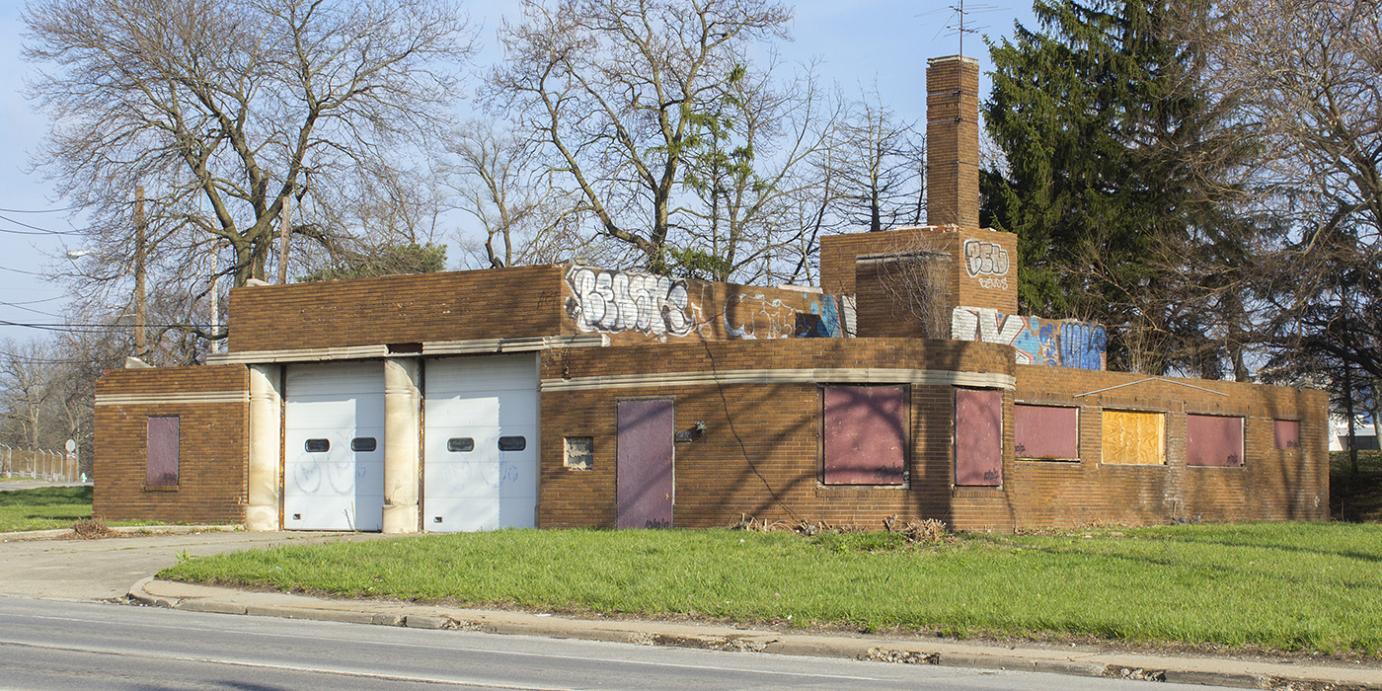
Fire Station #18, located at Washington Street and Tibbs Avenue on the west side of Indianapolis, is the earliest of the two Pierre & Wright designed fire stations represented in our collection of Pierre & Wright drawings. They both have a similar, Art Deco style with curvilinear walls of windows flanking the central fire truck bays.The fire department moved out of #18 when they built a larger building; however this Art Deco gem still stands today, although it is in need of preservation. Below is a description of the building soon after it was built, that appeard in American Builder magazine in June 1937.

Functional modernism is the order of the day--now even fire stations are models of efficiency in planning and construction. The building above, Fire Station #18, in Indianapolis, lacks the classic bell tower, brass poles, and elaborate stalls which characterized such buildings of twenty years ago. Instead it is compactly planned on a single floor with an exterior having modern lines and clean cut decoration.

The layout shows a central apparatus room, the entrance equipped with upward acting doors. Dormitories on both sides provide bunk room for the fire company; the locker room with showers and toilets extends across the rear and is directly connecting with sleeping quarters. At one side of the front there is a pleasant, well lighted recreation or lounge room with fireplace and a small office adjoining to the rear. Opposite are placed the dining room and kitchen. The small tower which can be seen in the exterior view is used to dry hose and not house the fire bell, as was the former function of such details.

Construction is fireproof, with masonry walls of haydite concrete block and brick facing, reinforced concrete floor, concrete ceiling slabs on steel joists and steel casement. The cost was approximately $20,000; Pierre and Wright of Indianapolis were the architects responsible for the efficient planning and modern appearance of the structure.

Images: Fire Station #18 photograph, ca. 1937 [34-216], Fran E. Schroeder Architectural Records; Presentation Drawing photostat, construction drawing, 1936 [3-41], Pierre & Wright Architectural Records, Drawings + Documents Archive, Archives and Special Collections, Ball State University Libraries.

Monday, June 25, 2012

Arthur B. Henning Architectural Records Available Online


The Drawings + Documents Archive's collection of Arthur B. Henning Architectural Records has recently been digitized for enhanced research and discovery, and is available online in the Ball State University Libraries' Digital Media Repository. This digital collection consists of photographs, sketches, reference material, and ephemera from the office of architect Arthur B. Henning, from Anderson, Indiana. The collection spans from 1922-1980 and includes architectural drawings by architect Erwin F. Miller. Henning worked for Miller and later bought the firm; he acquired the drawings at that time. Henning's drawings were sold to a subsequent firm. Drawing sets are for projects in Madison County and include schools, residences, brewery facilities, and a business.

The bulk of the collection consists of Henning's projects, which were primarily schools, churches, government buildings, libraries, hospital and businesses in Anderson, Indiana, and surrounding Madison County. Some of his largest projects were City Hall, Community Hospital, Fire Department Headquarters, and Anderson High School, all in Anderson, Indiana. Other projects include multiple buildings on the Anderson College campus, Central Christian Church, First Methodist Church, and numerous schools in the area. Items in the collection include photographs, building dedication booklets, newspaper clippings, articles, and reference books.

One of his most outstanding projects is the threatened Anderson High School gymnasium, the second-largest high school gymnasium in the country. After the community of Anderson consolidated its two remaining high schools in recent years, the former Anderson High School and gymnasium were left vacant. The Wigwam, as it is known, has been a vital part of the community since its construction and dedicated preservationists are currently looking for new uses for the building. Above is a two-page spread from the building's dedication booklet, when the future burned bright for this gymnasium.

Tuesday, June 19, 2012

The beginning of the Ball State University College of Architecture & Planning


Until the College of Architecture and Planning was established at Ball State University in 1965, Indiana students who wanted to become architects had to leave the state because none of the state schools offered an architecture program. The board of directors of the Indiana Society of Architects keenly felt this lack of educational opportunity affected their profession negatively and began planning to discuss the matter at the State Legislature in January 1961.

This article dates from October 9, 1960, shows the Indiana Society of Architects meeting at the Tavern Hotel in New Albany, Indiana, to plan their proposal. The agenda reads:

1. Establishment of a school of architecture in Indiana.
2. Revision of architect registration laws in Indiana.

Architects in attendance include Fran Schroeder, Wayne Weber, Alfred Porteous, Walter Scholer, Jr., Jim Walker, Harry Hunter, Ralph Knapp, R. J. Schultz, and Don Gibson. Fran Schroeder, from whose collection this article can be found, is shown seated, the third person from the left.

Friday, June 8, 2012

E. F. Marburger and Son Building, 1819 N. Meridian Street, Indianapolis


My mother always told me not to judge a book by its cover, but now I'm starting to feel the same way about building facades. Take, for example, the E. F. Marburger and Son building at 1819 N. Meridian Street in Indianapolis. Does the elegant, original facade perhaps still reside behind the urban renewal-era facade?

The historic photo can be found in the Drawings + Documents Archives' Fran E. Schroeder Architectural Records. The building was likely designed by the esteemed architecture firm of Pierre & Wright because Schroeder worked for the firm at that time. A natural historian, Schroeder often kept photographs and documentation related to his participation in architects' organizations as well as building projects throughout his lengthy career. 

Images: E. F. Marburger and Son building photograph, ca. 1930. [34-214] Fran E. Schroeder Architectural Records, Drawings + Documents Archive, Archives and Special Collections, Ball State University Libraries.

Google street view, image accessed 8 June 2012.

Tuesday, May 15, 2012

Indiana Landmarks 10 Most Endangered: Pantheon Theater, Vincennes


Built in 1921 by Vincennes architect John B. Bayard, the Renaissance Revival-style Pantheon Theater in Vincennes, Indiana, has hosted decades worth of performances. From local theater groups to Broadway shows, this building has seen it all. It was even where legendary performer and Vincennes-native Red Skelton got his start in show business.

Its current fate is a little less star-studded, however, which has prompted its debut in the spotlight of the 2012 Indiana Landmarks 10 Most Endangered list.

The images of the theater were most likely taken not long after it had opened in 1921. They are part of the Jay C. Bixby Architectural Records. Architect Jay C. Bixby (1889-1983) was working in Bayard's office by 1927 and then, along with another architect Rudolph W. Schucker, took over the firm after Bayard's death in 1933. Bixby later practiced independently from 1952 to 1965. The collection contains photographs, architectural drawings, and clippings regarding their projects throughout southern Indiana. 


Images: Pantheon Theater facade and interior. Jay C. Bixby Architectural Records, Drawings + Documents Archive, Archives and Special Collections, Ball State University Libraries.

Friday, May 4, 2012

Indiana Landmarks 10 Most Endangered: House of Tomorrow


Cellophane curtains, rubber floors, ashtrays and lampshades like kitchen utensils, and kitchen utensils like parlor ornaments, tables that rise up in the air like a Joshua tree, enameled walls and wooden dishes, furniture made of mirrors, game boards inlaid on the floor, these are some of the brand new ideas which puzzle and fascinate the crowds shuffling through the model houses around Home-Planning hall.
World's Fair Weekly

To Hoosier architects and designers, visiting the 1933 Century of Progress International Exposition held in nearby Chicago, must have been the highlight of their summer. Intended to celebrate Chicago's 100 year anniversary, the fair featured the latest innovations in architecture, design, products,transportation, science, and technology.

One of the prominent displays at the exposition was The Homes of Tomorrow exhibition that showcased thirteen houses designed for modern and, sometimes, futuristic living. Five of the houses--the Florida Tropical, Rostone, Armco Ferro, Cypress Log Cabin, and the House of Tomorrow--were purchased after the exposition and moved to Beverly Shores, Indiana, where they provide breathtaking views of Lake Michigan.

You can see the houses as they were on display in these pictures from the booklet that architect Fran E. Schroeder purchased when he attended the exposition in July 1933. He brought back other ephemera from his trip, all of which can be found in his collection at the Archives. Another architect, Leslie F. Ayres, sketched drawings while he was there. A few years later Ayres would design Muncie's Wilkinson House, a house that also makes an appearance on this year's 10 Most Endangered list.

Decades at the shore haven't been kind to the houses and Indiana Landmarks has partnered with the National Park Service to allow long-term leases to people dedicated to restoring these buildings. I recently had the privilege to tour all but the House of Tomorrow, which is the only one that hasn't found a benefactor. The luxury house once featured a garage for the family car and airplane, but today it is in poor condition and on this year's 10 Most Endangered list.

Taken during my visit, the photograph below shows the completely renovated Florida Tropical house taken from the vantage point of the balcony belonging to its neighbor across the street, the nearly complete Armco Ferro house.


Images: World's Fair Weekly, week ending July 22, 1933. Fran E. Schroeder Architectural Records, Drawings + Documents Archive, Archives and Special Collections, Ball State University Libraries. 
Florida Tropical House, 2012. Photograph by Carol Street.